Web cookies (also called HTTP cookies, browser cookies, or simply cookies) are small pieces of data that websites store on your device (computer, phone, etc.) through your web browser. They are used to remember information about you and your interactions with the site.
Purpose of Cookies:
Session Management:
Keeping you logged in
Remembering items in a shopping cart
Saving language or theme preferences
Personalization:
Tailoring content or ads based on your previous activity
Tracking & Analytics:
Monitoring browsing behavior for analytics or marketing purposes
Types of Cookies:
Session Cookies:
Temporary; deleted when you close your browser
Used for things like keeping you logged in during a single session
Persistent Cookies:
Stored on your device until they expire or are manually deleted
Used for remembering login credentials, settings, etc.
First-Party Cookies:
Set by the website you're visiting directly
Third-Party Cookies:
Set by other domains (usually advertisers) embedded in the website
Commonly used for tracking across multiple sites
Authentication cookies are a special type of web cookie used to identify and verify a user after they log in to a website or web application.
What They Do:
Once you log in to a site, the server creates an authentication cookie and sends it to your browser. This cookie:
Proves to the website that you're logged in
Prevents you from having to log in again on every page you visit
Can persist across sessions if you select "Remember me"
What's Inside an Authentication Cookie?
Typically, it contains:
A unique session ID (not your actual password)
Optional metadata (e.g., expiration time, security flags)
Analytics cookies are cookies used to collect data about how visitors interact with a website. Their primary purpose is to help website owners understand and improve user experience by analyzing things like:
How users navigate the site
Which pages are most/least visited
How long users stay on each page
What device, browser, or location the user is from
What They Track:
Some examples of data analytics cookies may collect:
Page views and time spent on pages
Click paths (how users move from page to page)
Bounce rate (users who leave without interacting)
User demographics (location, language, device)
Referring websites (how users arrived at the site)
Here’s how you can disable cookies in common browsers:
1. Google Chrome
Open Chrome and click the three vertical dots in the top-right corner.
Go to Settings > Privacy and security > Cookies and other site data.
Choose your preferred option:
Block all cookies (not recommended, can break most websites).
Block third-party cookies (can block ads and tracking cookies).
2. Mozilla Firefox
Open Firefox and click the three horizontal lines in the top-right corner.
Go to Settings > Privacy & Security.
Under the Enhanced Tracking Protection section, choose Strict to block most cookies or Custom to manually choose which cookies to block.
3. Safari
Open Safari and click Safari in the top-left corner of the screen.
Go to Preferences > Privacy.
Check Block all cookies to stop all cookies, or select options to block third-party cookies.
4. Microsoft Edge
Open Edge and click the three horizontal dots in the top-right corner.
Go to Settings > Privacy, search, and services > Cookies and site permissions.
Select your cookie settings from there, including blocking all cookies or blocking third-party cookies.
5. On Mobile (iOS/Android)
For Safari on iOS: Go to Settings > Safari > Privacy & Security > Block All Cookies.
For Chrome on Android: Open the app, tap the three dots, go to Settings > Privacy and security > Cookies.
Be Aware:
Disabling cookies can make your online experience more difficult. Some websites may not load properly, or you may be logged out frequently. Also, certain features may not work as expected.
Twisting in the Wind: The Politics of Tepid Transitions to Renewable Energy
Why do governments insist on fossil fuels? Why do renewables face uncertain and inconsistent legal and regulatory circumstances that slow their market-share growth against fossil fuels? Oksan Bayulgen studies the political determinants of partial energy reforms that result in tepid energy transitions and shifts the geographical focus from front-runner countries of energy innovation to developing countries, which have become the largest carbon emitters in the world. Her in-depth case study of energy policies in Turkey over the past two decades demonstrates that energy transitions are neither inevitable nor linear and that they are often initiated if and only when promoting renewables is in the interests of governing elites and stall when political dividends associated with energy rents change. This book contributes to the debates on the nature and pace of energy transitions by analyzing the power dynamics and political institutions under which energy reforms are initiated and implemented over time. This timely topic will be of interest to scholars, policymakers, energy investors, and anyone interested in environmental studies.
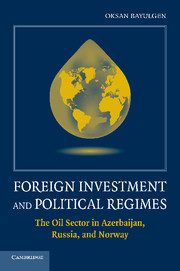
Foreign Investment and Political Regimes: The Oil Sector in Azerbaijan, Russia, and Norway
Political democratization and economic globalization have been two of the most important global trends of the past few decades. But, how are they connected? Do the domestic political institutions affect a country’s attractiveness to foreign investors? Can countries that democratize attract relatively more foreign investments? Drawing on three in-depth case studies of oil-rich countries and statistical analyses of 132 countries over three decades, Oksan Bayulgen demonstrates that the link between democratization and FDI is nonlinear. Both authoritarian regimes and consolidated democracies have institutional capabilities that, though different, are attractive to foreign investors. Democracies can provide long-term stability, and authoritarian regimes can offer considerable flexibility. The regimes that have started on the road to democracy, but have not yet completed it, tend to have political institutions that provide neither flexibility nor stability. These hybrid regimes, then, also find it relatively more difficult to construct a policy environment that is attractive to foreign investments. These findings have deep implications for the link between democratization and globalization, but also how globalization may affect political, social, and economic development.
Selected Articles:
Bayulgen, Oksan, Carol Atkinson-Palombo, Mary Buchanan, and Lyle Scruggs. 2021. “Tilting at Windmills? Electoral Repercussions of Wind Turbine Projects in Minnesota.” Energy Policy 159: 112636.
Bayulgen, Oksan. 2020. “Localizing the Energy Transition: Town-Level Political and Socio-Economic Drivers of Clean Energy in the United States.” Energy Research & Social Science 62: 101376.
Bayulgen, Oksan, and Salil Benegal. 2019. “Green Priorities: How Economic Frames Affect Perceptions of Renewable Energy in the United States.” Energy Research & Social Science 47: 28–36.
Bayulgen, Oksan. 2015. “Microcredit and Political Empowerment in Azerbaijan and Kazakhstan.” International Journal of Development Issues 14(2): 130–48.
Bayulgen, Oksan. 2013. “Giving Credit Where Credit Is Due: Can Access to Credit Be Justified as a New Economic Right?” Journal of Human Rights 12(4): 491–510.
Bayulgen, Oksan. 2013. “Two Steps Forward, One Step Back: How Politics Dim the Lights on Turkey’s Renewable Energy Future.” Perceptions: Journal of International Affairs 18(4): 71–98.
Bayulgen, Oksan, and Ekim Arbatli. 2013. “Cold War Redux in US–Russia Relations? The Effects of US Media Framing and Public Opinion of the 2008 Russia–Georgia War.” Communist and Post-Communist Studies 46(4): 513–27.
Bayulgen, Oksan. 2008. “Muhammad Yunus, Grameen Bank and the Nobel Peace Prize: What Political Science Can Contribute to and Learn From the Study of Microcredit.” International Studies Review 10(3): 525–47.
Bayulgen, Oksan, and Jeffrey W. Ladewig. 2007. “Democratization and Success in the Global Economy: Are They Compatible?” The International Journal of Interdisciplinary Social Sciences: Annual Review 2(1): 321–28.
Bayulgen, Oksan, and Jeffrey W. Ladewig. 2007. “Examining the Different Types of Foreign Capital and Their Political Effects.” The International Journal of Interdisciplinary Social Sciences: Annual Review 2(1): 161–68.
Bayulgen, Oksan. 2021. “Byzantine Energy Politics: The Complex Tale of Low-Carbon Energy in Turkey.” In Low Carbon Energy in the Middle East and North Africa, International political economy series, eds. Robin Mills and Li-Chen Sim. palgrave macmillan, 155–83.
Bayulgen, Oksan. 2015. “Human Right to Credit.” In Human Dignity and the Promise of Human Rights, ed. Richard P. Hiskes. New York, NY: Open Society Foundations.
Bayulgen, Oksan. 2009. “Caspian Energy Wealth: Social Impacts and Implications for Regional Stability.” In The Politics of Transition in Central Asia and the Caucasus: Enduring Legacies and Emerging Challenges, Central Asian studies series, eds. Amanda E. Wooden and Christoph H. Stefes. London: Routledge.
Bayulgen, Oksan. 2003. “Political Elite Integration and Differentiation in Russia.” In Elites and Democratic Development in Russia, Routledge studies of societies in transition, eds. Anton Steen and Vladimir Gelʹman. London ; New York, NY: Routledge.